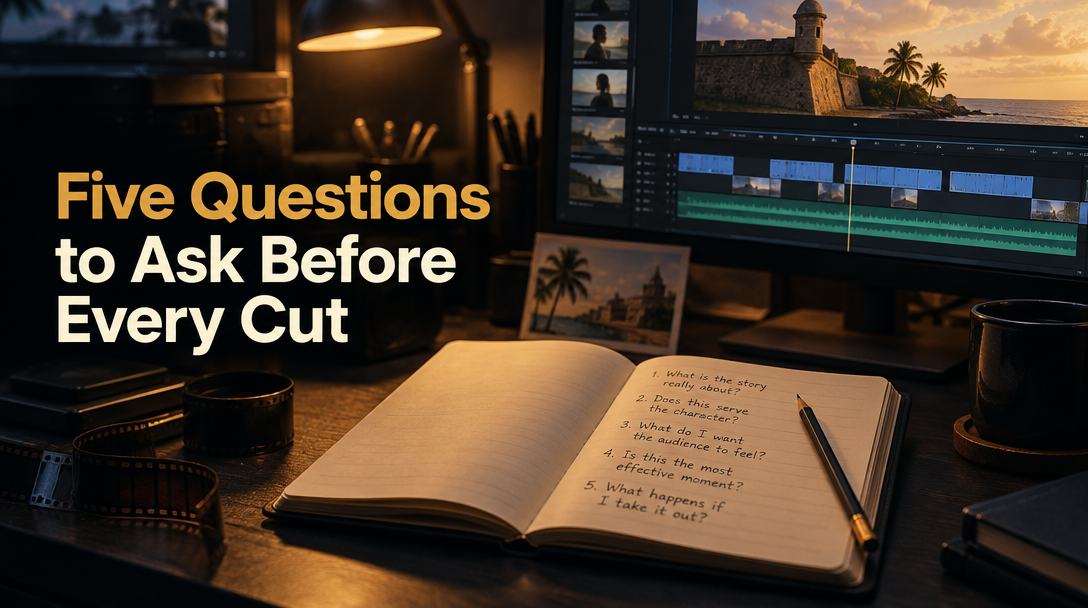
Five Questions to Ask Before Every Cut
There is a moment, late at night in the cutting room, when the timeline stops looking like footage and starts looking like a wall. You have watched the same scene forty times. Every take feels equally important. And the hand on the mouse hesitates, because you are not quite sure what the next cut should say.
I have been in that moment more times than I can count. Over two decades, I have learned that the cut is rarely a technical problem. It is a question you have not asked yet.
So before I make any cut, I write five questions on a page. They are simple. They are also the reason many of my scenes finally breathe.
1. What does the audience know right now?
Every cut gives the viewer something new, and takes something away. Before you cut, ask what the audience understands at that exact frame. If they already know the answer, the next shot should ask a new question. If they are lost, the next shot should bring them back.
I once spent a whole afternoon on a scene that felt confusing. The actors were excellent. The problem was that I had given the audience the answer before they had a chance to wonder about it. One cut, moved three seconds earlier, fixed everything.
2. Whose feeling is this shot about?
A cut can follow the character who is speaking, the character who is listening, or the object in the middle of the room. Each choice tells the viewer where their heart should be. When a scene feels cold, I often find that the camera is watching the wrong person.
Ask yourself whose emotion matters most in this moment. Then build the cut around that person, even if it means losing a shot you love.
3. Does this moment need to be seen, or only felt?
Not every action needs a close-up. Sometimes a door closing off screen says more than the door itself. Sometimes a held shot of an empty chair is the strongest image in the film.
When I am unsure, I ask whether the audience needs to see the action or just sense it. The answer often shortens the scene and makes it more powerful.
4. What is the rhythm asking for?
Every scene has a pulse. Some want to race. Others want to rest. Before you cut, listen to the rhythm of the dialogue, the music, and the performance. Then match it, or deliberately break it for a reason.
I often hum the scene to myself while I edit. It sounds silly, but it keeps me honest. If the cut does not sit in my body, it will not sit in the audience’s.
5. Would I miss this shot if it were gone?
This is the hardest question, and the most important. We fall in love with our favorite takes, sometimes for reasons that have nothing to do with the story. A beautiful line reading. A lovely glance. A moment we remember from the set.
Be brave enough to remove it if the answer is no. The story is always more important than the shot.
The lesson behind the questions
These five questions taught me something bigger than editing. They taught me to slow down before I act, to look at what is really happening, and to serve the people in front of me instead of my own pride.
Life asks us the same questions. What do the people we love already know? Whose feelings are we ignoring? What can we let go of to make room for something truer?
The next time you sit down with a difficult scene, write the five questions on a sticky note and place it on your monitor. Then answer them honestly, one cut at a time.
Thank you for reading. May your next cut be the one you did not expect, but the one the story needed.
José Delio Ares García, award-winning feature film and trailer editor from the Dominican Republic.