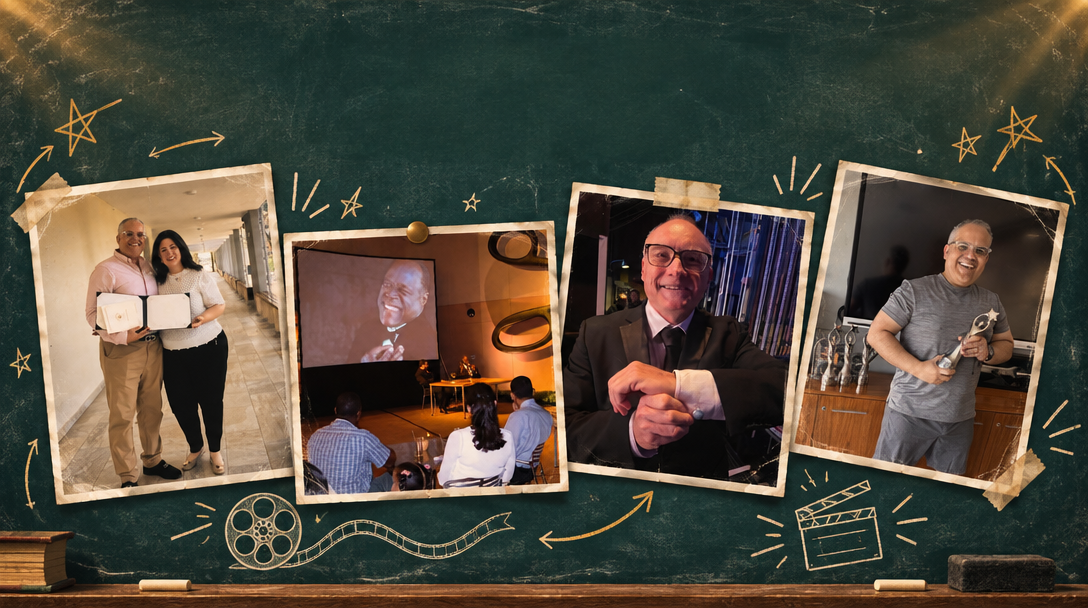
How I Finally Graduated from School, 28 Years Later
Anyone reading this title will probably think: “What? Twenty-eight years for a high school diploma? What a failure!” Honestly, I wouldn’t blame them.
On paper, this sounds like one of the biggest failure stories in the history of Carol Morgan School. After all, I supposedly graduated in 1998.
Supposedly.
On graduation day, they handed us beautiful black folders. Inside those folders was the graduation program, and a perfectly empty space where the diploma was supposed to go. Some of us had failed to complete all the credits and had to go through summer school. CMS was tough. Tough in the best way possible. And for some of us, the diploma would arrive later.
Mine took 28 years.
I still remember that empty folder stinging me. My brother found it this year, in 2026, while cleaning out old boxes. He drove to my house all giddy, handed me the empty folder, and when I opened it and saw it was empty, he joked that I probably never even graduated. He has accumulated diplomas throughout his life.
I hadn’t.
Formal education was never my strength
So when he handed me that folder and laughed, something inside me went quiet. Honestly, I wasn’t sure anymore.
Before I continue, a small warning: memory has a funny way of sanding down the uglier moments and making the beautiful ones glow brighter. If I’m being honest, I’ll probably sell parts of this story for more than they’re worth.
But the story starts here, in 2003. By then I had already dropped out of college. I had spent years DJing, clubbing and rebelling, trying to figure out who I was and what I wanted to dedicate my life to. But one thing never left me.
A question from my time at CMS stayed with me forever. Mr. Duggan asked us: “Who do you want to be?” My answer was strange. I said:
“I want to work with the most famous people possible while nobody knows who I am.”
That became the blueprint of my life.
Years earlier, back in 1989, CMS had given us another assignment: “What do you want to be when you grow up?” Most kids answered doctor, lawyer, astronaut. I answered: “Film editor.” People laughed. And honestly, I now understand why.
Back then, Dominican cinema barely existed
Wanting to become a film editor in the Dominican Republic sounded about as realistic as becoming an astronaut without a space program.
But I had seen an interview with Michael Kahn, Steven Spielberg’s legendary editor. They asked him what he did. His answer was simple: “I make the movies.” Not direct them. Not star in them. Make them. Right there, at nine years old, I knew. Not the man on the screen. The man shaping the story.
Fast forward to 2003
My father was working with Johnny Ventura, one of the greatest Dominican artists of all time. Through a series of events that still feel surreal today, I found myself producing and shaping a DVD project called Soy Johnny Ventura, alongside fellow CMS alumnus Jonathan Letellier (Class of 1997).
What started as a risky project became the biggest-selling Dominican DVD of its time. At 24 years old, I touched my first major success, and my first million dollars. I thought I had made it.
Then I failed spectacularly.
With all the confidence and arrogance of youth, we decided: “If the DVD is this successful, let’s put it in movie theaters.” Terrible idea. We rented theaters, spent fortunes on marketing, and thought we were invincible. Nobody showed up.
I still remember sitting in the office of Victor Carrady from Caribbean Cinemas after the disaster. He looked at me and said something that would shape the rest of my career:
“Give the people what they want, and they’ll reward you.”
That sentence became one of the foundations of my life in cinema. But failure didn’t stop me. It made me curious. Around that time I discovered one of the greatest hacks of my career.
The Global Film Festival, organized by FUNGLODE, brought Hollywood filmmakers, actors, producers and executives to the Dominican Republic every year. To make their stay possible, each guest was assigned someone to accompany them throughout their visit. Most people saw it as being a guide. I saw it as access. Anyone would have given anything for a one-hour meeting with some of these Hollywood legends. I was being offered entire days. So I volunteered.
Doors open when you stop waiting for permission
Over the years I accompanied remarkable people, including Omar Sharif and members of his family. Through those experiences, I learned something important: most successful people stop being intimidating once you spend enough time around them. They become human.
Then one year, I was assigned to a filmmaker named John Singleton, the director of Boyz n the Hood. For seven days we talked about movies, ambition, failure, life and purpose. Somewhere along the way, he stopped treating me like a guide and started treating me like a friend. That friendship continued for years.
Through John I met producers, executives and filmmakers connected to some of Hollywood’s biggest productions. I found myself in rooms I never imagined entering.
One of those moments came when I accompanied William Fay, then President of Legendary Pictures, to the signing of the Dominican Republic’s Cinema Law. I still remember sitting there while President Leonel Fernández signed legislation that would help transform Dominican cinema forever. When everyone got up and left, I stayed seated. Because I knew. The impossible dream I had written down as a child inside CMS suddenly had a chance of becoming real. For the first time, Dominican cinema had a future.
And maybe so did I.
But by 2009, none of that mattered anymore. The money was gone. My car was repossessed. My credit cards were maxed out. I was living with my parents again.
Then one day I got a call from John Singleton. He told me: “Get on a plane and come to Brentwood. I’ll give you room and board.” I couldn’t believe it. Then he added: “Bring your high school diploma and your college degree.” Reality hit me harder than ever before. I had no college degree. No formal career path. No green card. And to top it all off, I wasn’t even sure I had a high school diploma.
That moment broke me.
At 29 years old, while many of my friends already had careers and families, I thought I had permanently failed. Yet strangely enough, that was the moment my real life began. When every traditional door closed, I stopped waiting for permission. I prayed. I rebuilt. I learned humility.
That season destroyed the arrogant version of me that believed toughness meant ego and self-sufficiency. Life taught me something else: sometimes the strongest thing a man can become is humble.
During those years, CMS alumni kept appearing in my life like lifelines. Juan Tavares (Class of 1995) gave me opportunities through Messenger Mag that helped me invest in myself. With money earned through those projects, I flew to Madison, Wisconsin, and became certified through Sony Pictures.
In true JD fashion, I rented a limousine and showed up in a suit. I’m pretty sure they thought I was there to buy the company. I wasn’t. I was just trying to convince myself my dream was still alive.
Another alumnus who never stopped believing in me was Gamal Haché (Class of 1994). During some of my hardest years, when money was scarce and confidence was scarcer, Gamal always had a plate of food waiting for me and a reminder to trust the process. What mattered wasn’t the meal. It was knowing somebody believed I would eventually make it.
Alberto Rey (Class of 1998) gave me an opportunity through Conéctate when I desperately needed direction. There was always another alumnus opening a door.
And somewhere in the middle of all that chaos, I met my wife, Elizabeth. She believed in me before I believed in myself again. She sat through cuts at three in the morning. Watched unfinished edits. Helped sharpen my instincts. Helped shape the man I would become. If there is one person most responsible for the life I built after 2009, it is her.
Then cinema finally arrived.
The films, and the industry they helped build
In 2012, fellow CMS alumnus Antonio Alma (Class of 1988) gave me my first real opportunity to edit a feature film. Then came ¿Quién Manda? With that success, I moved to Entrepeneur Films, then Bou Group, and then we co-founded Caribbean Films, and with it came Colao. Then Qué León. One after another.
Today, the films I’ve helped shape have sold more than 11 million tickets, reached audiences in over 100 countries, streamed in dozens of languages, and won a combined nine Soberano Awards. Along the way, I’ve had the privilege of working with some of the most talented artists in our region, including Grammy-winning icons like Juan Luis Guerra, helping expand Dominican cinema and storytelling far beyond our borders.
I helped create companies, platforms and distribution systems that contributed to the growth of modern Dominican cinema. From DVDs to streaming platforms like Pelidom, I somehow found myself helping build an industry that barely existed when I was a child dreaming about editing movies inside CMS classrooms.
Then something happened that nine-year-old JD could never have imagined. In 2023, I was inducted into American Cinema Editors, ACE. One of the most prestigious editing organizations in the world.
Sitting beside me was Sarah Broshar, longtime collaborator of Steven Spielberg. The same Sarah Broshar who worked directly with Michael Kahn. The same Michael Kahn whose interview had inspired me as a child to become a film editor.
Sometimes dreams don’t come true exactly the way you imagine. Sometimes they come true in ways that are even better.
Then came May 14th, 2026
I walked back into CMS with my wife. The hallways felt familiar and completely different at the same time, like revisiting a childhood film remastered in 4K. They walked me into what used to be the counselor’s office. And there it was. The diploma. For the first time in my life.
When I opened the folder and saw it, tears ran down my face. And when I got back into the car with Elizabeth and closed the door, I cried.
Not because I became successful. Not because of awards. Not because of Hollywood. I cried because for the first time in my life, I felt worthy of holding it.
At eighteen, that diploma would have felt like possibility. At forty-six, it finally felt earned.
The man who walked out of CMS that day was not the same young man who walked out in 1998. He was a man shaped more by life than by formal education. More by failures than certificates. More by grind than trophies. A man who had gone to hell and back. A man who had learned humility, discipline, integrity, gratitude and resilience. And maybe that’s what graduation really is. Not the day you receive the paper, but the day you finally understand what it meant.
If there’s one thing I learned through all of this, it’s that failure is the best teacher. Once you accept that, you stop fearing it.
To the CMS Class of 1998, thank you for the friendship, inspiration, support and countless moments that helped shape the man I eventually became. In the end, CMS wasn’t just a school. It was the family that kept appearing every time life pushed me to the edge. And maybe life only guarantees three things after all: death, taxes, and the education that shapes the person you become.
And 28 years later, I can finally say: I graduated from Carol Morgan School.
Thank you.
José Delio Ares García, award-winning feature film and trailer editor from the Dominican Republic, and now, Carol Morgan School graduate.